Thursday, May 20, 2010

Parrington's Report: Day Two, Villa Diodati

Day Two: Geneva continued


Just as I thought the humans had finally began showing signs of acquiescing with my master plan for finding the monster, a.k.a Frankie Jr., I was once again shoved into a backpack and forced to endure museum after museum of artifacts totally unrelated to our mission.

The day began well. I managed to convince the humans to make the trek to Cologny, bordering Geneva, to the Villa Diodati. Lord Byron rented the villa in 1816 and invited Mary Godwin (later Shelley), Percy Shelley, and Claire Clairmont to visit in the summer. In what is commonly referred to as “the haunted weekend,” the four, along with Byron’s physician John Polidori, cast a wager as to who could tell the most horrific gothic tale. Inspired by this bet, M. Shelley conceived the idea of a man, unnaturally born and made of the dead, and over the course of the next year gave birth to Frankenstein; or the Modern Prometheus.
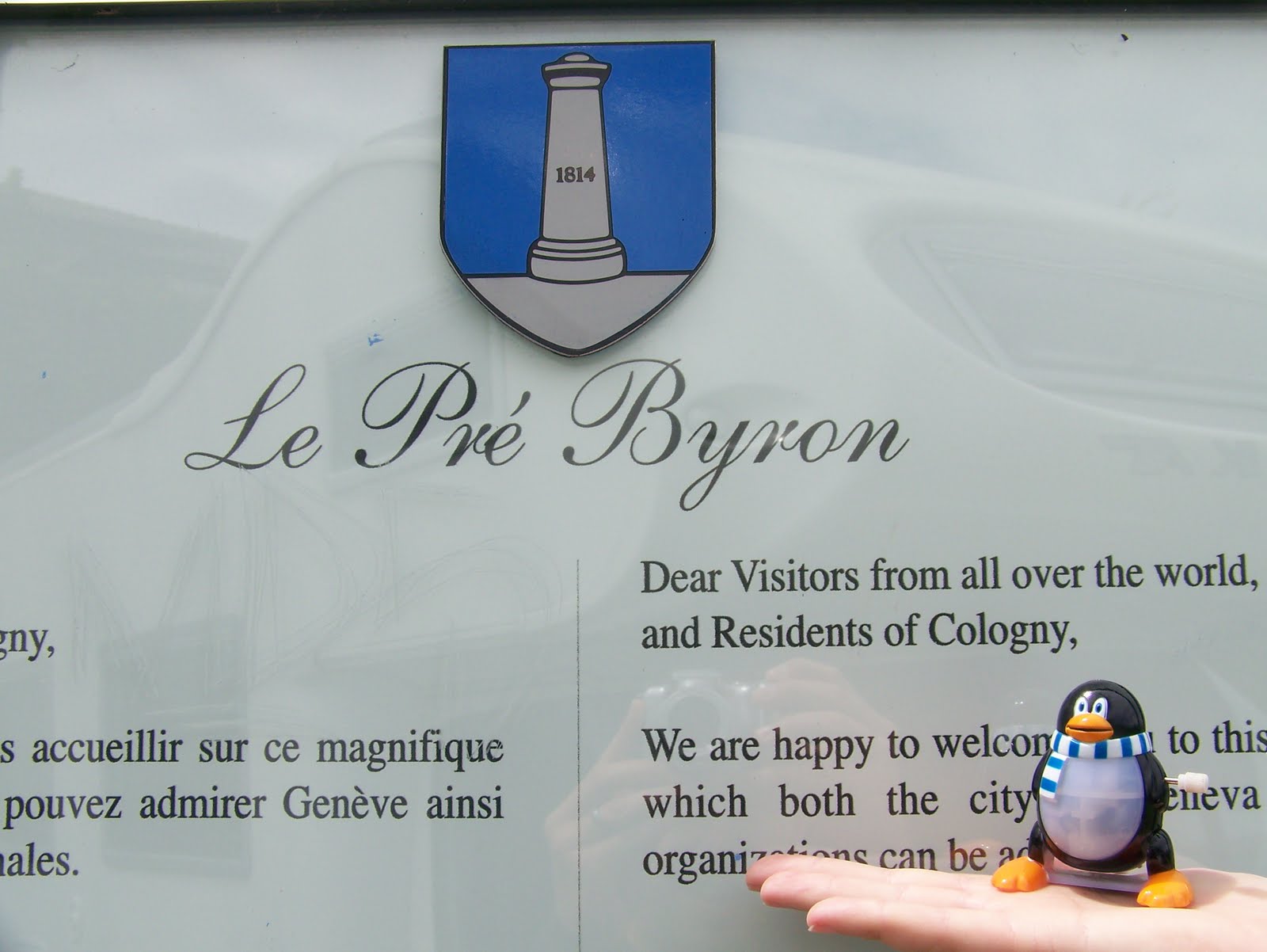


In order to create a working psychological profile for a missing person, which is absolutely necessary for accurate predictions of where a person may flee, and why, I believe you must begin at the beginning. The humans “graciously” agreed to travel to this villa, where I spent the morning perched on Byron's Stone, in Byron's Field, staring out over lake Geneva and asking myself, “If I were a huge diabolical monster that cannot die because I am born of the dead, where would I flee?”


Just as I was really getting into the character and psychologically becoming Frankie Jr., the humans got bored, shoved me back in the backpack, and didn’t take me out until dinner. As such, I am forced to allow the girl human to continue our day two report.

Disgruntled,

Parrington

Valerie's Report: Day Two, A Little Piece of Heaven


So, how do you spell heaven? R-E-A-L-L-Y-O-L-D-B-O-O-K-S! After leaving the beautiful Villa Diodati, Derrick and I (oh yeah, and Parrington) popped into the Martin Bodmer Library and Museum, at which point we completely geeked out. This place is amazing! Not only does it house an incredible papyrus collection, including some of the oldest copies of both Old and New Testament books, a Gnostic gospel, and two Egyptian Books of the Dead, its vast collection of first edition literature and original musical compositions (lots of Shubert, and a little Bach, Mozart, and Beethovan) is unbelievable. I’ll list off a few, just to give you a little taste:


• Late 13th century, Homer’s The Iliad

• Pre-1489, Virgil, The Aeneid

• 14th century, Ovid, Metamorphoses

• 15th century, Plato, Phaedon

• Late 9th century, Augustine, Retractions

• 1517 first edition, Martin Luther, Theses (one of only 3 copies!)

• Gutenberg Bible

• 1378, Dante’s Divine Comedy

• 1430, Chaucer’s Canterbury Tales

• 1516, first edition, Thomas More, Utopia

• Pre 1030, Mahayana Sutra

• 920, Buddhanama Sutra

• First folio edition, 1623, Shakespeare, Comedies, Histories, Tragedies

• First edition, 1609, Shakespeare, Sonnets

• First edition, Macbeth

• First edition, Othello

• A whole bunch of other Shakespeare

• 1633, first edition, John Donne, Poems

• 1667, first edition, Paradise Lost

• First edition of The Origin of Species and The Descent of Man

• Not to mention a whole bunch of Nietzsche, Freud, Marx, Engels, Charles Dickens, Tolstoy, Poe, Lewis Carroll, etc.


And as if that was not enough mental stimulation for one day, we hopped a bus back over to Old Town and explored the Musée D’art et D’histoire Geneva, which houses a massive collection of archeological finds from Egypt, Greece and Italy, as well as hundreds of paintings and sculptures dating from pre-dark ages to the present.


And, again, as if that was not enough, we explored St. Pierre’s Cathedral. Built in the 12th and 13th centuries, the massive cathedral was built on top of a Christian sanctuary dating back to 400 AD. Originally built as a Catholic cathedral, the people of Geneva voted to convert the congregation to Protestantism in 1536. In addition to beautiful stain-glass windows, wooden pews, and completely stone structure, the cathedral boasts a 6,000-pipe organ. There are only three words that can appropriately describe this place, A-Maz-Ing.


In short, this day was a little taste of a Lit major’s heaven.


Valerie

Wednesday, May 19, 2010

Wilmington to Geneva

Day One: Wilmington to Geneva


Despite all my protests against it, the FBI has assigned two newbies to accompany me on Mission Frankenfind. They cite their reasons as being my small stature, lack of opposable thumbs, and unfortunate reliance on a human to wind me up for the day, but I know the truth. They are afraid that, if I succeed (oh, and I will succeed) in finding the creature, the public may not be ready for the media reports of a penguin agent. I disagree—after all, look how well the public responded to the knighting of Sir Nils Olav.

Typical of new recruits these days (the bureau is quite desperate), these two newbies, which I will henceforth refer to as “the humans,” are a disaster. Rather than go over the case files and develop a plan of action, these two dimwits chose to sleep and watch free movies through the entire red eye from New York to Geneva. I don’t think they care about this mission, or take me seriously as a leader. Despite my warnings that flying economy makes me cranky, rather than my usual first class accommodations the girl human shoved me in the magazine/barf bag sleeve, and repeatedly knocked me in the head when she lowered her tray table.


She also insists on carrying me in the front pocket of her backpack, where my superb observational skills are useless to this mission. Both of them threatened to leave me at the airport when, after their US passports raised not an eye, the customs officials took me in for questioning, asking why a penguin has a Taiwanese passport. The girl human talks of nothing but chocolate and cheese, and the boy human stares down each restaurant in Geneva as though he hasn’t eaten in a week. Though neither will even hear of sushi for dinner. Plus, I caught them conspiring together while I was attempting to brief them on the case—sneaking peeks at a museum list behind my back and whispering about how a creature made of the dead should remain lost. I may be made of plastic, and a bird, but I’m wise to these fools. They think the bureau has handed them an all expenses paid vacation with the small catch of having to humor the penguin on his quest. I’m on to you humans! I will find the monster with or without you! The next time their backs are turned, no doubt shoveling down their next gluttonous conquest, I will sneak away, find the monster, and return to the US with all the glory. These two will be exposed for what they really are—chocolate and cheese covered tourists.

Til tomorrow,

Parrington


Saturday, May 15, 2010

Meet Parrington


Victor Frankenstein, natural philosopher and well-intentioned (though hopelessly short-sighted) inventor, has filed a missing persons report on his long described "abominable" creation.  It seems Victor finally read The Ugly Duckling and has had a change of heart regarding his aesthetically challenged son. The self-described monster, made completely of cadaver parts, was last seen escaping to the isolated icelands of the North Pole.  Though missing for almost 200 years, Victor feels confident his son is still out there, brokenhearted and homesick. He wants to make amends by finally providing his son with a suitable mate, Frankensteina.


This is Parrington the Penguin, and he's the missing person's FBI agent who has been assigned to the case.  Though his usual case load is lower profile--relocating children's runaway imaginary friends--the FBI, viewing Victor's case as both a lost cause and insane delusion, have tossed the case to Parrington.  As this case offers the overworked and under appreciated  penguin his first shot at finding a live--well, made-of -the-dead-but-somehow-breathing--being, he hopes successfully solving this case will bump him all the way up the proverbial ladder, passed escaped pets, directly to the missing mascots division.  After months of thorough planning, he has decided to begin his search at the site of both Mary Shelley's inspiration (the creature's mother?) and the monster's first hideout--the Swiss Alps. This journey will no doubt be perilous for such a small (and plastic) traveler, but with his dapper scarf, beak full of Swiss francs, and armed (or flippered) with Percy and Mary Shelley's 1817 travel journal as a guide, he's up for the challenge.

 In fact, he's flippin' excited!

Parrington plans to upload his case files to this blog daily, including clues to the monster's whereabouts, pictures, videos, and stories of the adventures, and near tragedies, he will certainly encounter.

Friday, May 7, 2010

Shelley's Gothic Sublimity

Mary Godwin, Percy Shelley, and Claire Clairmont traveled from England to France and Switzerland twice, once in 1814 and again in 1816. The group spent the first of these trips traipsing through the Swiss Alps, and the second at Lord Byron’s summer estate on Lake Geneva. The spectacular landscapes surrounding the glaciers of Chamonix and Mont-Blanc, overlooking Lake Geneva, inspired both Percy Shelley and Mary Godwin Shelley’s theories of Nature’s sublimity, which becomes a prominent theme in both authors’ writings following these tours. This theme first surfaces in their collaborative 1817 publication, History of a Six Weeks’ Tour, which includes travel journals from the 1814 tour, Percy Shelley’s poem “Mont Blanc,” letters written during the trips, and essays grappling with political issues of the time. Mary Shelley’s later works, Frankenstein and Matilda, expound upon the theories first presented in Six Weeks’ Tour, using Nature as both character and metaphor. The tourists’ time at Lord Byron’s estate on Lake Geneva, the destination of their 1816 tour, inspired Mary Shelley’s Frankenstein. Her revolutionary novel incorporates and relies upon landscapes from both tours to contrast Nature’s sublimity against the social, political, and scientific revolutions of nineteenth century England. Mary Shelley continued to utilize nature as metaphor, character, and theme throughout her writing career. Shelley’s Nature commands awe and reverence, while remaining indifferent, even antagonistic, to human plights. Victor Frankenstein’s creation escapes to the beautiful, but hostile, Swiss Alps while Matilda dies alone on a Scottish plane. Despite the reverence both Victor Frankenstein and Matilda feel towards Nature’s beauty, both fall ill—terminally ill in Matilda’s case—after exposure to the elements.


Shelley’s descriptions of nature evoke breathtaking images, while her characters are injured, sickened, and even die as a result of exposure to storms, severe climates or dangerous topography. As Nature is both a driving force and a silent character in much of Shelley’s work, I want to see the landscapes that claimed her devotion. Though she, Percy Shelley and Claire Clairmont toured through France as well as Switzerland, it was Mary Shelley’s time in the Swiss Alps and on Lake Geneva that is directly referenced in so much of her writing. I hope to follow her movements through the Alps, stopping where she stopped and seeing the landscapes that commanded her gaze.


Excerpt from “A Chronology of Mary Shelly” published in Oxford World’s Classics 1998 edition of Mary Shelley’s 1818 Frankenstein; or, The Modern Prometheus:


1814 (May) Returns to Skinner Street; meets Shelley again (28 July) Mary, accompanied by her stepsister, Claire Clairmont, elopes with Shelley. Travel through France and Switzerland, and return to England (August-September)


1815 (February) A girl-child born prematurely to Mary and Shelley, but dies a few days later (August) Settled with Shelley at Bishops Gate, Windsor (September) On the recommendation of Percy’s physician, William Lawrence, the Shelleys take a journey by river to Oxford


1816 (January) A son, William, born (May) Mary and Shelley, with Claire Clairmont, leave England for Geneva, where they meet Lord Byron (who has already formed a liaison with Claire) and his physician Dr. Polidori (June) Mary, Shelley, and Clair setle at the Maison Chappuis, at Montalègre, close to Byron at the Villa Diodati at Cologny, near Geneva. Frankenstein begun (July) Expedition to Chamonix and the Mer de Glace (September) Return to England (October) Suicide of Fanny Imlay, Mary’s half-sister (December) Suicide of Shelley’s first wife, Harriet. Mary and Shelley married at St Mildred’s Church, Bread Street, London (30 December)


1817 (March) Move to Marlow. Shelley refused custody of his children by his first marriage (May) Frankenstein completed (September) daughter Clara born History of a Six’ Weeks Tour published


1818 (March) Mary and Shelley, with Claire and the children, leave for Italy. Frankenstein published (June) Settled for two months at Bagni di Lucca (September) Move to Este. The baby Clara dies in Venice. Visits to Byron in Venice (November) Journey south to Rome (December) Settle in Naples for the winter